
By David Tian, Ph.D.
Ph.D., University of Michigan, specializing in moral psychology. Former tenure-track professor of philosophy, National University of Singapore. Certified IFS Therapy Practitioner (Level 3). Brown University Certified Leadership Coach. Private adviser to founders and high achievers.
Key Takeaways
- The restlessness, the dread, the inability to sit still — these are not three problems. They are one problem, and the problem is that the capacity to be alone with oneself was never built during the years of striving.
- Loafing is not laziness and not recovery. It is unstructured time spent on nothing in particular, by a person who has met his obligations and now has hours that belong to him only. The achiever has created no category for this.
- The Daoists taught that striving is a disease and that the cultivated person’s natural state is unhurried, attentive, and available to whatever the day brings. Wu wei wu bu wei (無為無不為) — non-action, and yet nothing is left undone.
- Aristotle taught that leisure (scholē σχολή) is the activity that work exists to make possible. To use the productive years to make more productive years is to confuse the means with the end.
- Seneca taught that most successful people are busy with what does not matter to them and die without having owned their own time. Otium is the only context in which the hours become one’s own.
- Modern positive psychology has confirmed the convergence: flow, autonomy, and deep relationships — the three reliable producers of fulfillment within an individual’s control — all require the unstructured time the achiever does not permit himself.
- Part of The Good Life series.
The founder is forty-three, single, and has not been alone with himself for fifteen years.
He does not put it that way. He puts it as: he is restless. He cannot sleep without the room being cold and a podcast playing. He has not read a novel in three years that he did not abandon by chapter four. He has been to therapy and stopped because the therapist kept asking him to stay with feelings he could not stay with. He runs five kilometers a day, which is not exercise — it is the only twenty-five minutes he can stand to be inside his own head, and only because the running is loud enough to drown most of it out.
The exit closed seven months ago. The number was good. He has more than he needs and less than he wanted. He thought the feeling on the other side of the exit would be relief, or pride, or at least a clear new direction. The feeling has been none of those. The feeling has been a low background hum of dread that he cannot trace to any specific thing in his life, because there is no specific thing in his life that is wrong. The company sold. The acquirer is honoring the terms. He is healthy. He is wealthy. He is, by every external measure, in a position a thousand of his peers would trade their lives for.
What he cannot do, and has not been able to do since he was twenty-eight, is sit in a room with no input and be okay. Three minutes of silence and his hand reaches for the phone. Ten minutes and he is on a treadmill or in the gym or on a call he did not need to take. An hour and the dread is loud enough that he is texting a woman he does not actually want to see or booking a flight he does not really need to take.
He flew to Bali six weeks ago to reset. Five-star villa, ocean view, no calls scheduled. By day four he was sketching the next venture on the back of a room-service menu. By day six he was home. He told his sister the trip was a successful reset. He believed it. The honest description is that he could not stand the villa for a week, and he does not yet know why.
This essay is about why. The thesis is that the restlessness, the dread, the inability to sit still — these are not three problems. They are one problem, and the problem is not that something is wrong with his life. The problem is that he never built the capacity to be alone with himself with nothing happening, and the capacity he did not build is the same capacity in which a life worth living gets built. The ancient Daoist tradition, Aristotle, and Seneca all reached this conclusion from different starting points more than two thousand years before modern psychology began rediscovering it through research on flow, autonomy, and deep relationships.
Why High Achievers Cannot Tell Loafing Apart From Laziness
Loafing is unstructured time with no agenda, no productive purpose, and no plan to be anywhere or accomplish anything. It is the kind of afternoon in which a person discovers, slowly and without trying, what he actually wants when nothing external is asking for output.
This is not the same as laziness. Laziness is avoidance of effort that the lazy person believes he owes. The loafer owes nothing to anyone in the loafing time. He has cleared the obligations, paid the bills, fed the people who depend on him, and now has hours that belong to him.
It is also not the same as recovery. Recovery is repair after damage, time off taken so that more work can happen later. The post-exit founder who flies to Bali to recharge is doing recovery. He has not loafed. He has scheduled rest as input to the next round of output.
The achiever cannot tell these apart, because the only category he has for non-work is recovery. Time that is not producing must be repairing the capacity to produce. If it is doing neither, it is wasted. This is the worldview he has lived inside since he learned to read.
Loafing belongs to a different worldview entirely. It says that some of the most important hours in a human life are the ones in which nothing is being produced and nothing is being repaired, because those are the hours in which the person discovers what is actually his — what he likes when no one is asking, what he thinks about when nothing is forcing him to think about anything, who he is when his calendar does not tell him.
Why the Ancient Daoists Said Striving Was a Disease
The Chinese tradition with the deepest engagement on this point is the Daoist one. The two foundational texts are the Daodejing 道德經 (the Tao Te Ching) and the Zhuangzi 莊子, both from the fourth century BCE or earlier. In the twentieth century, Lin Yutang’s The Importance of Living (1937) recovered the Daoist position for a modern audience in English. The book has stayed in print for nearly ninety years because it answers a question modern life keeps producing: how to enjoy being alive when no one is forcing you to.
The Daoist position begins with a vocabulary problem. The central concept is wu wei (無為), which translates word-for-word as “non-action.” Academic translators usually render it as “effortless action” because “non-action” sounds like passivity, which is not what the Daoists meant. Both translations are partly right. Wu wei is action that arises without the controlling self getting in the way — the absorbed activity of someone who is no longer monitoring himself.
But there is a fuller phrase in the Daodejing: wu wei wu bu wei (無為無不為). “Do nothing, and yet nothing is left undone.” The cultivated person, in Daoist terms, does very little of what looks like striving from outside, and yet the things that need to happen, happen. It’s “non-action” because he has stopped fighting the grain of the situation. He simply sees what the moment requires and does it. He does not see what the moment does not require, so he does not do that.
The Zhuangzi makes the point through stories. The most famous is perhaps the butterfly dream. Zhuangzi falls asleep and dreams he is a butterfly. He wakes and does not know whether he is a man who dreamed of being a butterfly or a butterfly now dreaming he is a man. The point is not merely metaphysical confusion. The point is that the person who has loafed long enough stops being so sure he knows which of his selves is the real one. The achiever-self is one possibility. The contemplative-self is another. The achiever-self has been treated for thirty years as the only one.
The Zhuangzi also tells the story of the useless tree. A craftsman walks past an enormous old tree and does not bother to look at it. His apprentice asks why. The craftsman says the tree is useless — its wood is twisted, its branches are crooked, it cannot be made into anything. That night the tree appears to the craftsman in a dream and says: if I had been useful, I would have been cut down a long time ago. My uselessness is what allowed me to grow to this size and live this long.
The achiever has been useful for twenty-five years. The useful tree gets cut down at forty-seven and turned into a deck. The useless tree is still standing.
Lin Yutang took this material and made it argumentative for a Western reader. The Importance of Living claims that the cultivated person’s natural state is unhurried, attentive to small pleasures, available to whatever the day brings. Work is fine in moderation. Striving is a disease. A civilization that lost the capacity for loafing also lost the capacity to enjoy being alive, and was producing miserable people who believed their misery was a sign of seriousness.
This is the Daoist position. It is not argued the way a Western philosopher would argue it. It is presented as a way of seeing that the cultivated person recognizes from the inside. The post-exit founder, who has been a useful tree his entire adult life, does not recognize it. The work of recovering the recognition takes time and is not done in two weeks at a villa.
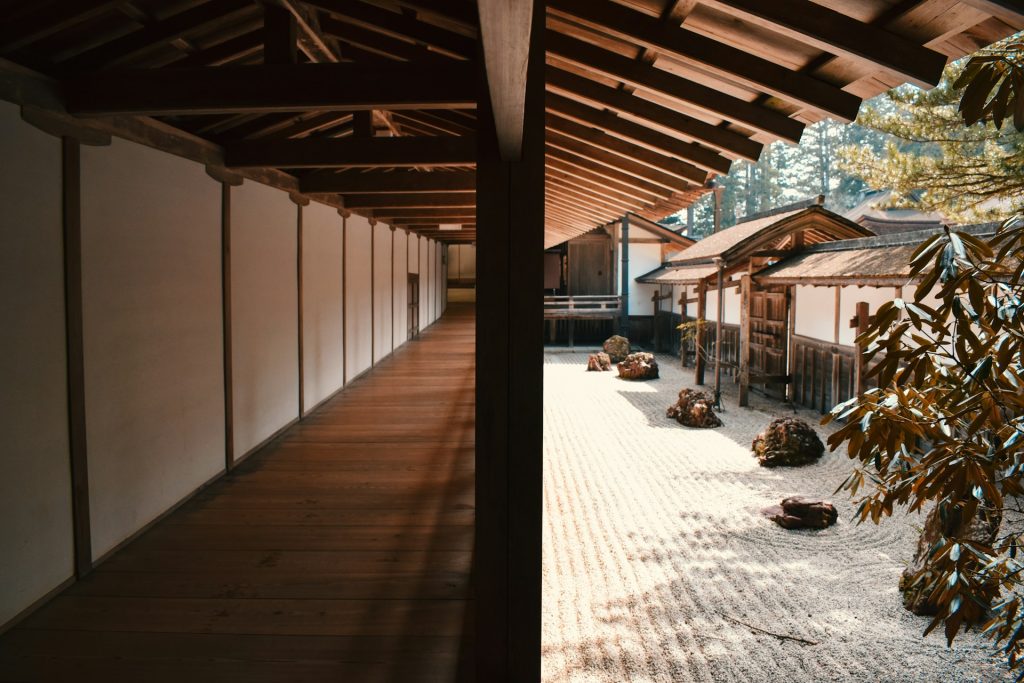
(The Zen tradition that grew out of the Chinese Chan school carried these Daoist instincts into Japanese Buddhism and developed them further, particularly in the practice of shikantaza and the aesthetics of the dry-landscape garden visible at the top of this essay. A full treatment would require its own essay. This one stays with the Daoist source.)
Why Aristotle Said Work Exists for Leisure, Not the Other Way Around
Twenty-three centuries ago, in Athens, Aristotle was working out a more argumentative version of a similar conclusion.
His key term is scholē σχολή — usually translated “leisure,” though that word in modern English has lost most of what the Greek meant. Scholē is the root of the English word “school.” For Aristotle, leisure was not the absence of work. It was the activity that work made possible.
The Nicomachean Ethics and the Politics both develop this. Work, including the activities that produce wealth and political success, exists so that leisure becomes possible. Leisure exists so that theoria θεωρία — sustained reflection on what is true and what is good — becomes possible. Theoria, in turn, is what makes a life flourishing rather than merely productive.
The order matters a lot. Most modern people, and certainly the achievers among them, have the order reversed. They treat work as the point of life and leisure as recovery for more work. They treat reflection as a luxury available after the productive years end, if ever. Aristotle thought this was a category error. The productive years exist so that the reflective life becomes possible. To use the productive years to make more productive years is to confuse the means with the end.
This is harder to hear than it sounds. The post-exit founder hears Aristotle and thinks: I have done the productive years. I have the means now. Reflection is on the menu. He sits down to reflect, and within ten minutes he is checking his phone or sketching the next venture. He cannot truly reflect because the capacity for reflection has not been developed. He spent the productive years building the capacity to execute, judge under pressure, persuade, and outwork the competition. He did not spend them building the capacity for theoria.
Aristotle would not have been surprised. He thought theoria was one of the four capacities a flourishing life required, and he thought it had to be developed through practice over many years, the way courage is developed through repeated acts of courage. The achiever who has practiced execution for twenty-five years has built execution. He has not built the rest. The deficit is now built into his situation, not a problem he can solve in a quarter.
The good news is that theoria can be developed starting now. The bad news is that it cannot be developed by treating it as a project. The way to develop it is to spend unstructured hours in the activity itself — sitting with a question, walking with a question, reading with a question, until the capacity to stay with the question without checking the phone starts to develop.
Why Successful People Often Reach the End and Realize They Never Lived
A few centuries after Aristotle, in Rome, Seneca wrote two short pieces that the post-exit founder will find harder to dismiss than most modern self-help: De Brevitate Vitae (On the Shortness of Life) and De Otio (On Leisure).
The opening of De Brevitate Vitae is famous: it is not that we have a short time to live, but that we waste much of it. The book is addressed to a successful Roman administrator named Paulinus, and it is in many ways a letter to the post-exit founder. Seneca’s claim is that most people who appear to be living a full life are not. They are busy with what does not matter to them, and they call it living because they have never sat still long enough to notice that what they are doing is not what they want.
The Roman senator who fills his day with court appearances, dinners with people he does not like, and obligations he did not choose has not lived. He has been alive, in the sense that his heart has kept beating. But the time has not been his. It has belonged to the people whose calls he took and the obligations he honored without examining. At the end of such a life, the senator looks back and realizes he never owned his own time. He never lived it. He passed through it.
The Latin word for purposeful leisure is otium. The Latin word for business is negotium — literally, the negation of otium. Roman culture took for granted that otium was the natural state and negotium was the deviation that had to be justified. Modern culture has reversed this. We take work for granted and require leisure to justify itself.
Seneca’s diagnosis is the sharpest of the three traditions for the post-exit founder, because Seneca was writing to exactly his demographic. He was not writing to Athenian citizens with their leisure built into the social structure. He was not writing to cosmopolitan literati with their Daoist temperament. He was writing to Roman senators, equestrians, and emperors — wealthy, powerful, ambitious men who had everything Roman society could offer and were, on Seneca’s reading, mostly dying without having lived.
The post-exit founder reading Seneca for the first time tends to have an unpleasant recognition. He has been Paulinus. The exit was supposed to make him not-Paulinus anymore. The two weeks in Bali were supposed to be him not being Paulinus. They were not. He was still Paulinus, just in a more luxurious villa, still failing to own his own time, still treating the unstructured hours as a problem to solve rather than the thing itself.
Seneca’s prescription is not relaxation techniques. It is the question that takes longer to answer than it sounds: whose time is this, actually? If the answer is not “mine,” who has it, and how did they get it, and what would it take to get it back?
Why Three Ancient Traditions All Reached the Same Conclusion About Idleness
Three traditions, three starting points, one convergence. The Daoists, Aristotle, and Seneca were not in conversation with each other. They were separated by language, geography, religion, and centuries. They reached overlapping conclusions about loafing from independent directions, which is the philosophical equivalent of three different scientific teams running different experiments and getting the same result.
The Daoist position is temperamental and aesthetic. The cultivated person knows from the inside that loafing is good. The work is to recover the capacity to know it.
Aristotle’s position is teleological. Leisure is what work is for. To use the means as if they were the end is to mistake the purpose of a human life.
Seneca’s position is about ownership of time. The busy life is a life whose hours belong to other people. Real leisure is the only context in which the hours become truly one’s own.
The convergence: loafing is not recovery. It is the activity par excellence. The hours in which nothing is being produced or repaired are not gaps in real life. They are the real life. Everything else is in service to them, or in flight from them.
The post-exit founder is likely to hear this and dismiss it as a luxury belief. Easy to hold if you have the means. But the three philosophers were not addressing the poor. Lin Yutang was writing for cosmopolitan Chinese intellectuals with money and education. Aristotle was writing for Athenian citizens — the leisure class of their society. Seneca was writing for Roman senators and emperors. They were writing for exactly the kind of person the post-exit founder is. They thought he was getting it wrong.
The traditions also do not agree that everyone is doing it wrong. They are quite specific about who. The peasant whose long hours are not his to refuse is not the target of the critique. The target is the wealthy and powerful man who has the means to own his time and does not, because he has built no capacity to use it.
Why Modern Psychology Confirms What the Ancient Philosophers Understood
Modern positive psychology has spent about forty years catching up to what the three traditions saw.
Mihaly Csikszentmihalyi’s research on flow established that absorbed engagement in a challenging activity is one of the most reliable producers of fulfillment available to a human being. Flow requires unstructured time. The achiever whose hours are blocked into fifteen-minute meetings cannot enter flow on his current calendar. He may have built a career on bursts of intense focus, but flow in Csikszentmihalyi’s sense — the prolonged absorbed state — requires the conditions the modern executive calendar specifically forbids.
The research on autonomy points in the same direction. Edward Deci and Richard Ryan’s self-determination theory identifies autonomy as one of three universal psychological needs. People with high autonomy report higher well-being than people without it, controlling for income. The post-exit founder usually has high formal autonomy — he owns his time, no one outranks him, his calendar is his to set. But functionally, he has very little autonomy, because his calendar fills with things other people are asking for, and he has not built the capacity to choose what to put on it.
The research on relationships is the heaviest of the three. The Harvard Study of Adult Development, now beyond its eighty-fifth year, has produced the most reliable finding in long-term well-being research: the quality of close relationships predicts adult life satisfaction more than any other variable, including wealth, status, and medical health. Close relationships require unstructured time the achiever does not give. He is present with his wife for thirty minutes a day, if that. He is present with his children for the school drop-off. And he is not present in the long, unstructured hours in which deep relationships are actually built.
Each of the three research findings independently confirms one piece of what the three philosophical traditions saw. Flow requires the loafing the achiever does not permit himself. Autonomy requires the ownership of time Seneca was naming. Deep relationships require the unstructured presence the Daoists were pointing at and Aristotle was building into his account of friendship.
The research validates the traditions. It does not replace them. The traditions add what the research cannot: an account of what kind of person it makes sense to want to be, and why.
Why Successful Founders Are the People This Matters Most For
The post-exit founder is in a position the three traditions would have recognized as ideal and tragic at the same time.
Ideal, because he has the two preconditions the traditions identified as necessary: the means and the time. He no longer has to work for money. He no longer has a calendar imposed by an organization. He has, in principle, the conditions of the Athenian citizen, the Roman senator, the Chinese literatus — the conditions in which a flourishing life becomes possible.
Tragic, because he has built none of the capacities that flourishing requires. He has spent twenty-five years building execution, judgment under pressure, persuasion, and outworking the competition. He has not built the capacity to loaf, the capacity for theoria, the capacity to own his own time. The capacities he built are no longer needed. The capacities he needs were not built.
This is not a moral failure. He did what the situation required. The situation produced a company, an exit, a fund, and a family. The situation also did not produce a man capable of using any of those things to live well. The capacity for that has to be built now, from a starting point of forty-seven years of disuse.
The good news is that the capacity can be built. The Daoists, Aristotle, and Seneca all thought it could. None of them thought it could be built quickly, and none of them thought it could be built by treating the building as another project. The capacity is built by spending unstructured hours in the activity itself, doing nothing in particular, until the doing-nothing stops being uncomfortable and starts being the thing it was always going to be: the activity in which the rest of the life becomes available.
The Bali trip was the right idea executed by the wrong man. The man who flew to Bali had the means to do nothing and no capacity to do nothing. He flew home early because the discomfort of his own unstructured hours was worse than the discomfort of going back to a calendar.
The work is not another two weeks in Bali. The work is the slow building, over months and probably years, of a capacity that has been waiting since university, when he last had unstructured time, owned by him, spent on nothing in particular, and did not know they were the thing he was supposed to be learning to use.
The Daoists called this the natural state of a cultivated person and said the civilization that lost it had lost the capacity to enjoy being alive. Aristotle called it the precondition of theoria and said it was what work was for. Seneca called it otium and said the busy life that did not include it was a life lived for other people. Modern psychology calls it the precondition of flow, autonomy, and deep relationships, and says without it the other goods are not available.
The founder has been hearing some version of this for years, usually from people he does not respect — the wellness coach, the meditation app, the friend’s wife who went to a retreat. He has dismissed it because the messengers seemed soft. The messengers were soft. The Daoists, Aristotle, and Seneca are not. They are among the toughest thinkers their civilizations produced. They thought the busy life was a wasted life. They were right.
The work, when the founder is ready, is not another goal. It is the slow recovery of a capacity that has been waiting for twenty-five years to be used.
Frequently Asked Questions
Why can’t I sit alone with my thoughts?
Because the capacity to sit alone with your thoughts has to be built, and the years of building a successful career did not build it. The achiever’s working life trained him to do, decide, persuade, and outwork. None of those capacities require sitting alone with anything. Most successful people reach their forties and discover that eleven minutes of silence is unbearable. The discomfort is not a sign that something is wrong with them. It is a sign that a capacity was not built. It can be built starting now, but it cannot be built quickly, and it cannot be built by treating the building as another project.
Why do successful people feel guilty when they’re not working?
Because they have built their identity on the capacity to produce, and being unproductive feels like becoming someone else, someone weaker. The guilt is a symptom of having confused the means of a life (work) with the end of a life (flourishing). Aristotle, the Daoists, and Seneca all thought this was the central error of ambitious people. The guilt is real. It is also evidence that the capacity for leisure has atrophied and needs to be rebuilt.
What did Aristotle say about leisure?
Aristotle thought leisure (scholē) was the activity that work existed to make possible. Work and the pursuit of wealth were instruments. Leisure was not the absence of work but the activity in which sustained reflection (theoria) on what is true and what is good could happen. To use the productive years to make more productive years was, on his account, to confuse the means with the end and to miss the point of having a human life.
Why do I feel restless even when I have time off?
Because the restlessness is not about the time off. It is about the absence of the external structure that has been pulling you forward for twenty-five years. The structure was doing more work than you realized — it was telling you what to think about, who to be, where to direct yourself. When it is gone, what remains is whatever you built underneath it. Most successful people built almost nothing underneath it, because the structure was so demanding that there was no capacity left over. The restlessness is the encounter with that absence. It is uncomfortable. It is also the first honest information about the inner life you have had in years.
Why does silence make me uncomfortable?
Because silence is the condition in which the parts of you that have been waiting for attention finally have a chance to speak up, and they have a lot to say that you have been arranging your life to not hear. The discomfort is not random. It is specific. Silence is uncomfortable in proportion to how much has been suppressed. The achiever who built a career on outrunning his inner life finds the silence after the exit harder than the silence before the climb began. The capacity to sit with the discomfort is the only path through it. There is no shortcut. The Daoist, Aristotelian, and Stoic traditions all knew this, and so does modern psychology.
Is it normal to be bored on vacation?
For an achiever, yes. The boredom is the absence of a familiar pulling forward, not a sign that vacation was a mistake. Most achievers have built no capacity to sit with unstructured time, because their working lives have not required it. The boredom is the first encounter with that missing capacity. The honest response is not to fill the time with new activities, but to stay with the discomfort long enough to discover what is on the other side of it.
What do you do after a successful exit if you don’t want another company yet?
The first move is not another goal. It is the slow recovery of a capacity that has been waiting since the productive years began — the capacity to spend unstructured time on nothing in particular, until the unstructured time stops being uncomfortable. The Daoists, Aristotle, and Seneca all thought this capacity was what work was for. The post-exit period is the first time in twenty-five years that it can actually be built.
Why does doing nothing feel so hard for high achievers?
Because the capacity for doing nothing (wu wei) was not built during the years of striving. The achiever spent twenty-five years building the capacity to execute, judge under pressure, persuade, and outwork the competition. He did not spend them building the capacity to loaf. The capacities are not interchangeable. Doing nothing is hard for him in the same way that running a marathon would be hard for someone who has never run. The capacity has to be built, and it takes time, and it cannot be built by treating the building as another project.
0 Comments