

Why You Don’t Feel Loved By People Who Think They Love You | (#110) Beyond Success: Psychology & Philosophy for Achievers, with David Tian, Ph.D.
You’ve thought the decision through and had good reasons for making it. But now you’re living with the results, and you keep wondering whether you chose wrong.
Maybe you ended a relationship and miss the person. Or you declined an opportunity and can’t stop thinking about what you gave up.
But if you take the painful consequences as proof of a bad decision, then you end up returning to the same toxic relationship, or restoring the original unresolved problem, or spending another year going back in circles. Or keep flip-flopping until you no longer trust yourself to make a good decision and follow through.
Yet, you can’t simply ignore your gut feelings, either. Sometimes they reveal a problem you overlooked.
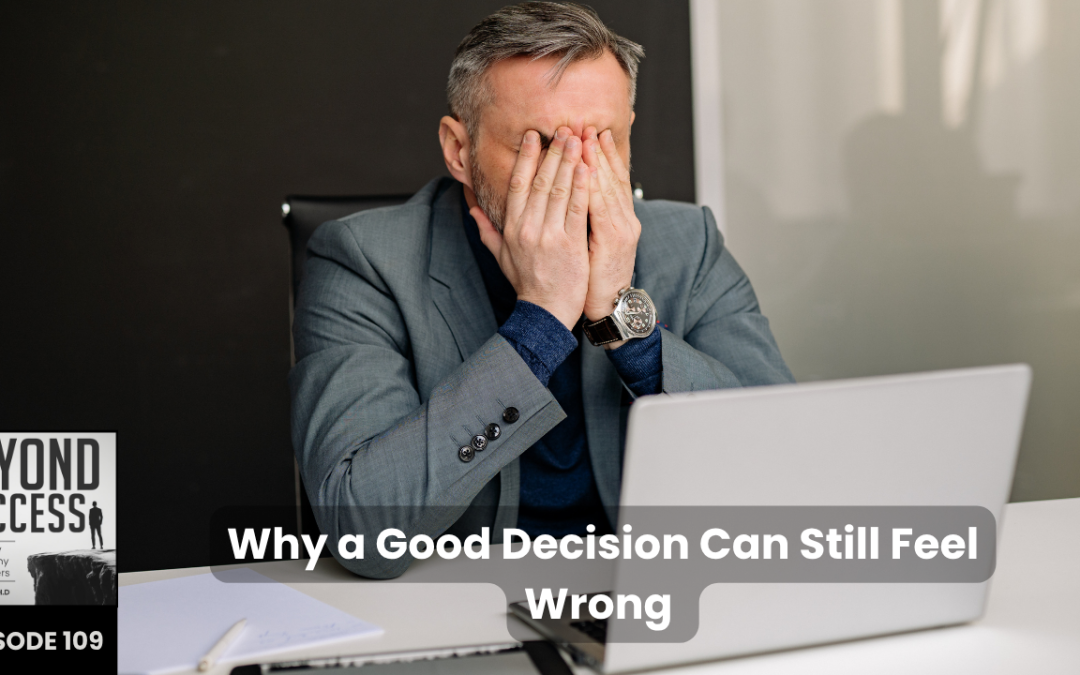
Why a Good Decision Can Still Feel Wrong | (#109) Beyond Success: Psychology & Philosophy for Achievers, with David Tian, Ph.D.
You’ve thought the decision through and had good reasons for making it. But now you’re living with the results, and you keep wondering whether you chose wrong.
Maybe you ended a relationship and miss the person. Or you declined an opportunity and can’t stop thinking about what you gave up.
But if you take the painful consequences as proof of a bad decision, then you end up returning to the same toxic relationship, or restoring the original unresolved problem, or spending another year going back in circles. Or keep flip-flopping until you no longer trust yourself to make a good decision and follow through.
Yet, you can’t simply ignore your gut feelings, either. Sometimes they reveal a problem you overlooked.
When Part of You Wants to Change & Part of You Doesn’t (Guided Meditation) | (#108) Beyond Success: Psychology & Philosophy for Achievers, with David Tian, Ph.D.
You’ve thought it through, and your decision makes sense. But then another concern comes up, and you can make just as good a case for doing something else.
After a while, you start to wonder whether you can trust your own judgment.
Being smart can make this harder, because you can build a convincing argument for whichever option you feel most pulled toward.
How to Trust Yourself When You Keep Changing Your Mind | (#107) Beyond Success: Psychology & Philosophy for Achievers, with David Tian, Ph.D.
You’ve thought it through, and your decision makes sense. But then another concern comes up, and you can make just as good a case for doing something else.
After a while, you start to wonder whether you can trust your own judgment.
Being smart can make this harder, because you can build a convincing argument for whichever option you feel most pulled toward.

What Would You Pay to Get Five Years Back? | (#106) Beyond Success: Psychology & Philosophy for Achievers, with David Tian, Ph.D.
Failure is easy to notice.
You build the wrong company, make a bad investment, or choose the wrong direction, and eventually the result tells you something went wrong.
Success can actually be harder.
Let’s say the company grows, the numbers improve, the sacrifices keep paying off.
Meanwhile, you may be giving up time with your spouse, your children, your health, or years of your life that you can never get back.
How to Live So Death Doesn’t Feel Too Soon | (#105) Beyond Success: Psychology & Philosophy for Achievers, with David Tian, Ph.D.
There’s a difference between wanting more time to live your life and needing more time to live your life.
You can want another twenty years because you love being alive. Or you can need them because you still haven’t built the relationship, started the family, or spent enough time with the friends you kept meaning to see.
The reasons for postponing those things may have been sensible. But the same reasons can keep you postponing them for another decade or more.

Why Someone Can Be Perfect on Paper But Only Feel Like a Friend
Shared interests don’t guarantee romantic chemistry. This client story explores how inherited expectations affected this man’s attraction and partner choices.

Why Finding a Partner Had Become So Important
He finally had the financial freedom he’d spent years working toward. Finding a partner seemed like the obvious next step. But as we looked more closely at what he expected that relationship to provide, a different problem emerged.
Would Your Life Matter If No One Remembered You? | (#104) Beyond Success: Psychology & Philosophy for Achievers, with David Tian, Ph.D.
What if your life disappeared so completely that no one remembered you?
No family stories. No company. No reputation. No influence. No trace that you were ever here.
Would that make your life meaningless?
There’s an award-winning episode of Star Trek that gets at this question better than most philosophy books.
It also exposes a bargain many of us make without noticing it: we treat the present as a kind of downpayment on future permanence.
Live longer. Build something that lasts. Leave a legacy. Make sure some part of you continues.
All of those things can be good.
But none of them is what makes a life worth living in the first place.

The Problem You Can See Is Not Always the True Problem
We usually try to solve the problem we can see. But when the same kind of problem keeps coming back, the visible problem may only be the clue. Sometimes you need to look further upstream to understand what’s really causing it.